

Save Money
$995 for your first show (gateway, 100 GB and standard shipping included), vs. $4,500 and up for a dedicated 10 Mbps venue line.
Easy to Set Up
Arrives preconfigured and cloud managed. Plug in and you’re online in a few minutes.
Proactive Live Support
With US-based team. Average response time is under a minute
More Reliable
Comes with (3) pre-installed enterprise tier SIMs for all major cellular networks


How Bonded Trade Show Internet Works
Three Carriers at Once. Booth Wi-Fi That Stays Up.
Trade Show Internet That Holds When Doors Open


Trusted by


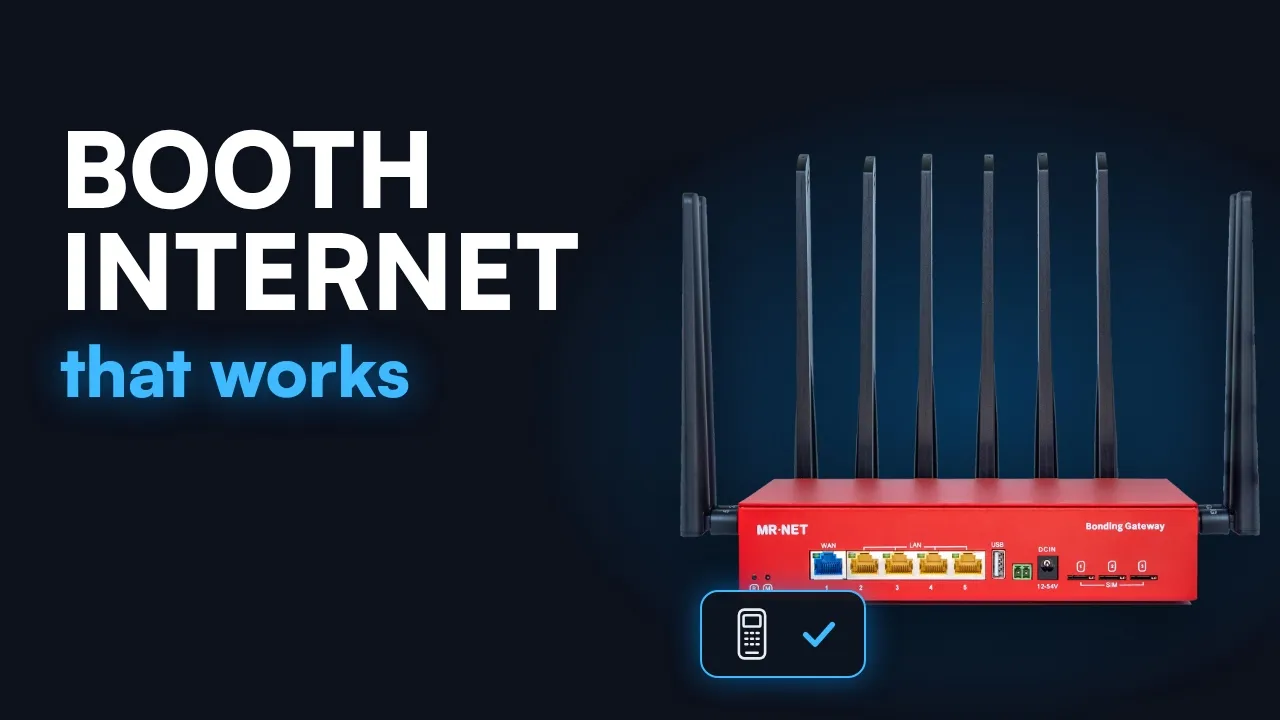
MR·NET 006 Plus
Cellular Bonding Gateway
1 Gbps LAN
2.5x Faster CPU
3 SIMs
Wi-Fi 6


250 Mbps
Maximum bandwidth
up to 6
Independent internet sources
Gigabit (1 Gbps)
Ethernet port speed
Wi-Fi 6 802.11ax
Built-in Wi-Fi (2.4/5GHz)
Hotspot, multi‑SIM or bonded?
Only one uses all three carriers.
All three run on cellular data. Here’s the difference on a busy show floor.
Phone hotspot
Your phone’s own connection.
One carrier
Slows down when that carrier is busy
Consumer data plan
Fine for a quick email check
Multi-SIM device
Several SIMs in one box.
Several carriers, one at a time
Switches carriers, never combines them
Plan tier depends on the SIMs
Fine as a backup link
MR·NET bonded cellular
Three carriers, one connection.
Verizon, AT&T and T-Mobile at once
If one slows, the other two carry on
Three enterprise-tier SIMs included
Built for demos, payments and streaming
Speed depends on carrier signal in your hall.
Trade Show Internet & Wi-Fi: 4 Options and the Catch in Each
Booth Wi-Fi That Keeps Up with a Full Hall
Deep Dive Conversations
With Industry Experts
Hear directly from industry leaders who rely on MR·NET for mission-critical cellular connectivity. In these interviews experts share how MR·NET has streamlined deployment, eliminated downtime, and significantly reduced total project costs.


Schedule a 15-minute demo consultation to discuss your connectivity needs
Also feel free to send an email to sales@mrnet.us or call us at (845) 666-0696.
Proven at Real Shows and Events


Choose a Plan
That Fits Your Needs.
Own it for every show,
or try one show first.
Prices exclude taxes (based on shipping location). Standard shipping is included in the first-show trial and is $24 on the annual plan. Prepaid data packages can be bought separately at checkout.
Venue internet vs MR·NET
Own it once. Use it at every show.
A venue sells a line for one show. MR·NET is one gateway for every show.
Venue internet
Printed 2026 advance rates at US convention centers, compiled in MR·NET’s venue guides.
Entry wired (exhibitor rates): $500 to $1,575
Dedicated 5 to 6 Mbps: $2,500 to $7,222
Prices rise after the order deadline
One venue, one show
New provider and setup at every venue
MR·NET
One gateway, every show.
$2,498 first year, gateway included
Then $1,499 a year
Data at $8/GB: 10 to 40 GB a show day
$995 first-show trial: gateway, 100 GB and standard shipping included; $300 credited toward the annual plan within 30 days after the trial
Same setup and support at every show
Estimate your yearly savingsDrag to set how many shows you exhibit at each year.
3
You save$13,402per year with MR·NETYear one, with 3 shows. From year two you save about $14,401 a year.
Compared with a 5 to 6 Mbps dedicated venue line at every show: the median 2026 advance rate across the 11 US convention centers in MR·NET’s venue guides that print exhibitor prices ($5,900). Data: 25 GB a show day (MR·NET customers use 10 to 40 GB) for a 3-day show at $8/GB. Excludes shipping and tax.
Everything included.
Nothing to configure.
Stop worrying about network drops and focus on your business. Our complete package delivers rock-solid internet through advanced cellular bonding technology
01
Cellular Bonding Gateway
Shipped pre-configured to you or your destination. Fully compatible with popular audio-video hardware and protocols. Advanced network settings supported. Shockproof Travel Case option available.
02
(3) Top tier SIM cards
All three major carriers work together for the best performance and coverage possible. Enterprise-tier SIMs on Verizon, AT&T and T-Mobile. Data billed at $8/GB; the first-show trial includes 100 GB. If you have needs outside the US, contact our sales team at sales@mrnet.us.
03
Bonding Server
Always optimized for your territory and use case. Cloud managed and monitored by our system and support team. Full redundancy. Scalable on demand.
04
After-hours live support
Proactive live support with US-based team. Our broadcast trained team responds in seconds, resolves issues in minutes. Reachable via online chat or by phone. Stay focused on your operations and leave network headaches to us.


Guides for popular trade show venues
MR·NET customers have deployed at every one.
Each guide covers the venue’s internet prices, order deadlines and rules, from its own documents.
Las Vegas Convention Center
Las Vegas, NV
$500 to $45,000
Early-order rates. Order 30 days ahead.
McCormick Place
Chicago, IL
$496 to $8,240
Organizer rates; exhibitors pay more. Order 14 days ahead.
Javits Center
New York, NY
$262.75 to $110,478
Early-order rates. Order 15 days ahead.
Orange County Convention Center
Orlando, FL
$1,095 to $39,050
Early-order rates. Order 30 days ahead.
Moscone Center
San Francisco, CA
$800 to $15,995
Early-order rates. Order 10 business days ahead.
Georgia World Congress Center
Atlanta, GA
$300 to $21,995
Early-order rates. Order 21 days ahead.
Anaheim Convention Center
Anaheim, CA
$795 to $39,050
Early-order rates. Order 14 days ahead.
The Venetian Expo
Las Vegas, NV
Quote only
No published prices. Order 21 days ahead for early-bird rates.
MR·NET is not affiliated with, endorsed by, or sponsored by any venue or venue service provider named on these pages. Nothing here is legal advice.
Got a question?
We've got answers.
Tried a hotspot last time? See why hotspots fail and what to bring instead →
How do I get internet for my trade show booth?
You have four options: order a line from the venue's exclusive provider, buy per-device venue Wi-Fi, use a phone hotspot, or bring your own bonded connection. According to MR·NET's 2026 Convention Center Internet Price Index, a dedicated 10 Mbps venue line runs $4,500 to $13,542 per show at early-order rates. MR·NET's gateway bonds Verizon, AT&T and T-Mobile into one connection for your booth, so it doesn't depend on venue Wi-Fi or one carrier. See prices venue by venue.
How much does trade show internet cost?
A dedicated 10 Mbps venue line costs $4,500 to $13,542 per show at early-order rates, according to MR·NET's 2026 Convention Center Internet Price Index, and prices rise after the order deadline. MR·NET is an alternative: one gateway that bonds Verizon, AT&T and T-Mobile. The annual plan is $2,498 for the first year, gateway included, then $1,499 a year, plus data at $8/GB. First-time customers can try one show for $995 with the gateway, 100 GB of data and standard shipping included.
What's the most reliable trade show internet?
One that doesn't depend on a single network or a consumer plan. A phone hotspot runs on one carrier, and venue Wi-Fi depends on the venue's network. MR·NET bonds Verizon, AT&T and T-Mobile into one connection for your booth: if one carrier slows or drops, traffic can move to the other two, though speed may dip while fewer carriers are active. That's true bonding, with all three carriers working at once. A multi-SIM router holds several SIMs and switches between carriers, which is not the same thing. Plan tier is a separate lever: MR·NET runs on enterprise-tier SIMs, not consumer phone plans, to help curb congestion in a full hall. Bonded cellular still needs signal in your hall, so check it at your booth before the show opens.
What's the best Wi-Fi for a trade show booth?
A private network from your own gateway. Public Wi-Fi at a venue is shared by everyone at the show, and a full hall puts many phones on the same towers, so a phone hotspot can slow down too. MR·NET's 006 Plus broadcasts your booth's own Wi-Fi from one bonded Verizon, AT&T and T-Mobile connection, so only your devices use it. If you'd rather buy the venue's Wi-Fi, our venue guides show each venue's published internet prices. Where outside wireless is restricted, switch the gateway's Wi-Fi off and connect over Ethernet.
What is cellular bonding?
Cellular bonding combines several cellular connections into one. The MR·NET gateway holds three SIMs, one each on Verizon, AT&T and T-Mobile, and uses all three at once. Your devices see a single connection, and traffic moves between carriers as signal and congestion change. That's different from a multi-SIM device, which uses one carrier at a time.
Can I use a phone hotspot at a trade show?
You can, and for a quick email check it may be enough. A hotspot uses one carrier on a consumer plan, and a full hall puts many phones on the same towers, so it can slow down or drop. For demos, payments or streaming, a bonded connection gives you three carriers on enterprise-tier SIMs. See what your venue prints in our venue guides.
What router do I need for a trade show booth?
A cellular bonding router, which uses several carriers at once instead of one. MR·NET's 006 Plus bonds Verizon, AT&T and T-Mobile, and its four Ethernet ports take laptops, card readers and screens, so you can run it with Wi-Fi off where a venue restricts wireless devices.
Is multi-SIM the same as bonding?
Not by itself. A multi-SIM router holds several SIM cards and switches between carriers. Bonding uses them together: the MR·NET gateway sends your traffic over Verizon, AT&T and T-Mobile at the same time, and the MR·NET cloud rejoins it into one connection. If one carrier slows or drops, traffic can move to the other two, though available speed can dip while fewer carriers are active. Plan tier is a separate lever: MR·NET's SIMs are enterprise-tier, not consumer plans.
Are outside Wi-Fi devices allowed at my venue?
Some venues restrict them, and the rule is usually printed in the in-house provider's service terms or the venue's Wi-Fi policy. Moscone Center's 2026 order form says "Customer/exhibitor provided wireless AP/router are not permitted on site." A May 2026 McCormick Place document covers 802.11 signals from "self-contained portable Wi-Fi systems." Neither mentions cellular gateways. Run MR·NET with its Wi-Fi off and your devices on Ethernet.
Is venue Wi-Fi worth paying for?
Sometimes. If you need a dedicated wired line with fixed bandwidth on the building's network, the venue's service is how you get it. If you can bring your own connection, compare the venue's printed prices with MR·NET's published pricing and your expected data use. They're different services: a venue line is fixed bandwidth, bonded cellular depends on carrier signal in the hall.
How much does MR·NET cost for a trade show?
The annual plan is $2,498 for the first year including the gateway, then $1,499 per year, plus data at $8/GB. To try it first, the first-show trial is $995: up to 30 days with the gateway, 100 GB of data and standard shipping, for first-time customers, one unit and one show. MR·NET customers typically use 10 to 40 GB per show day; 100 GB covers a 3-day show at 25 GB a day, and live video can use more. Data beyond 100 GB is $8/GB. If you then buy the annual plan within 30 days after the trial, $300 comes off its price. Shipping on the annual plan is $24 standard, and taxes are extra.
Can I rent trade show internet for a single show?
Once, as a first-time customer. The first-show trial is $995 and includes up to 30 days with the gateway, 100 GB of data and standard shipping. It is a trial of the service, so it cannot be ordered again. If you exhibit again, the annual plan covers every show for a year, and $300 of your trial price comes off it if you buy within 30 days after the trial. For several units or custom terms, contact MR·NET.
What happens to my unused data?
If you keep the gateway by buying the annual plan, your unused data stays on your account and never expires. For example, if you used 60 GB at your first show, the other 40 GB is still there when you buy. If you return the gateway, unused data expires.
What if I use more than 100 GB?
Data beyond the 100 GB included in the first-show trial is billed at $8/GB at the end of the month. You can watch usage in the cloud portal while you are at the show.
How does the $300 credit work?
At the end of your trial, you can keep the gateway on the annual plan, return it, or ask us to extend the trial. If you switch within 30 days after the trial ends, $300 comes off the $2,498 price, so your first year costs $2,198 plus data and tax. We apply the credit for you when you switch; it isn't applied at the website checkout.
Can I order the first-show trial again?
No. It is for first-time customers, one unit and one show. For your next show, choose the annual plan, or contact us for several units or custom terms.
How much data will my booth use?
MR·NET customers typically use 10 to 40 GB per show day. Live video and demos sit at the high end, email and card payments at the low end. The bandwidth calculator estimates your own use from quality, bitrate, frame rate, camera count and duration. Data is billed at $8/GB.
Do card readers and POS systems work?
Yes. Internet-connected POS systems and card readers run over the gateway with no POS reconfiguration. Connect them by Ethernet or Wi-Fi, then run a test transaction before the show. Payment providers set their own network requirements, so confirm yours. If your venue restricts outside wireless, plan to connect payment devices by Ethernet.
How long does setup take?
A few minutes. Gateways ship preconfigured with three SIMs installed, so setup is plug-and-play: power on the gateway and connect your devices. Do it at your office before the show, not on move-in day, so you can test your equipment. Then check signal again at your booth.
What happens if one carrier fails?
The gateway detects the failure and moves traffic to the remaining carriers, and session persistence keeps a video call or upload going. Speed drops with fewer carriers. If signal is weak on all three carriers in your hall, the connection suffers too.
Do I need an IT person?
No. Gateways ship preconfigured, so there's nothing to configure on your side. Plug in power, connect your devices, and watch the connection in the cloud portal. US-based support is available by chat or phone, including after hours. If your booth runs a larger network of equipment, someone who knows it helps, but the gateway itself doesn't need one.
What if my venue prohibits outside wireless?
Switch the gateway's Wi-Fi off. Your devices connect over its four Ethernet ports, your booth broadcasts no Wi-Fi, and the gateway never connects to the venue's network: it uses Verizon, AT&T and T-Mobile, like every phone at the show. The venue rules we've read are about wireless equipment and interference with the venue's network, and none mentions cellular gateways. Our support team can help you set it up.
Can the venue block or jam my hotspot or cellular gateway?
The FCC says venues may not intentionally block personal Wi-Fi hotspots. In Enforcement Advisory DA 15-113, the FCC Enforcement Bureau states that venues and their network operators may not intentionally block or disrupt personal Wi-Fi hotspots, and federal law prohibits jamming Wi-Fi or cellular signals. On the FCC's OTARD rule (47 CFR 1.4000): we found no FCC ruling applying OTARD to an exhibitor booth. A venue's own rules on outside wireless equipment are a separate question, so ask the venue and get its answer in writing. If outside Wi-Fi is the concern, the MR·NET gateway's Wi-Fi can be switched off so your booth devices connect over Ethernet only. If you suspect blocking, file a complaint at fcc.gov/complaints. This is not legal advice.
Last updated: November 5, 2026